
Credit Score Myths That Cost Real Money

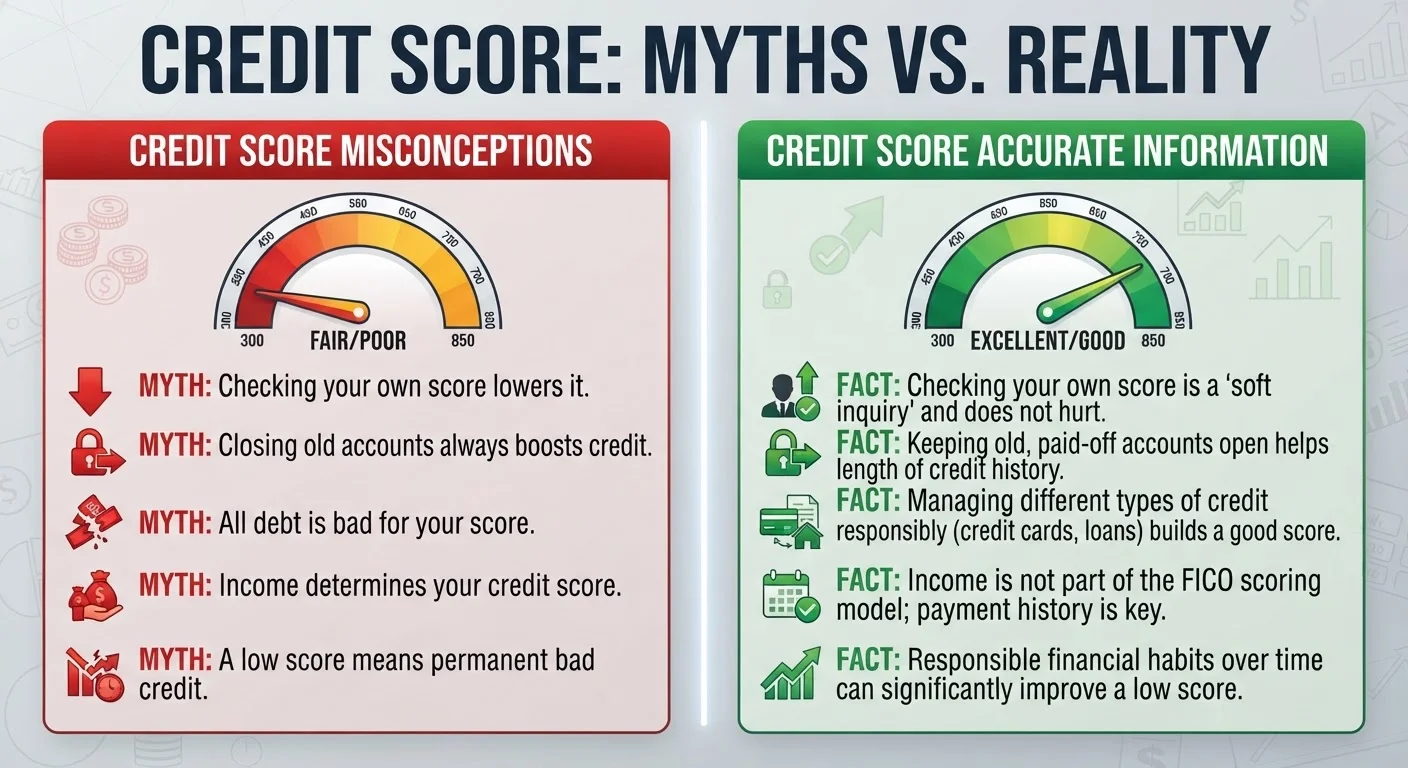
Photo: TrendingResults.net | Discover More, Trend More editorial
Key Takeaways
- Checking your own credit report never lowers your score - it's a soft inquiry.
- Closing old credit card accounts can actually hurt your score by reducing available credit.
- Carrying a balance month to month does not help build credit and costs money in interest.
- A high income does not directly improve your credit score - income isn't a scoring factor.
- Rate shopping for a mortgage or auto loan within a short window counts as a single inquiry.
Why Credit Score Myths Persist - and Why They Matter
Credit scores influence some of the largest financial decisions most people make - mortgage rates, auto loan terms, even some rental applications and insurance premiums. Yet a surprising number of widely held beliefs about how scores work are flat-out wrong. These myths don't just cause confusion; they cause people to make decisions that quietly raise their borrowing costs or slow down legitimate credit-building progress.
Part of the problem is that credit scoring models aren't fully transparent. Lenders license the models, and the full algorithm details aren't public. That opacity creates space for guesswork to fill in as fact. The good news: the major scoring factors are well documented, and understanding them correctly puts you in a meaningfully better position.
Myths Can Have Real Dollar Costs
This article breaks down the most common credit score myths, explains what the evidence actually shows, and helps you make decisions based on how scoring really works - not folklore.
The Myths, Corrected
The following myth-and-fact pairs address the misconceptions most likely to cost people money or stall their credit progress. Each correction is grounded in how the major credit scoring models - primarily FICO and VantageScore - actually calculate scores.
Myth
Checking your own credit report or score will hurt your credit.
Fact
Checking your own credit is classified as a soft inquiry and has zero effect on your score.
Credit inquiries come in two types. A hard inquiry occurs when a lender pulls your credit to evaluate a loan or card application - this can temporarily reduce your score by a few points. A soft inquiry occurs when you check your own credit, or when a lender pre-screens you for an offer. Soft inquiries do not affect your score at all, under any scoring model.
This myth keeps many people from monitoring their own credit, which is actually a financially healthy habit. You can check your reports at AnnualCreditReport.com at no cost. If you spot an error, the dispute process is a separate matter entirely - see our guide on common credit file errors and how to dispute them.
Myth
Closing old credit card accounts you no longer use will improve your score.
Fact
Closing accounts typically reduces your total available credit and can raise your utilization ratio, which may lower your score.
Your credit utilization ratio - the percentage of your available revolving credit that you're currently using - is one of the most heavily weighted factors in scoring models. When you close a card, you eliminate that card's credit limit from your total available credit. If you're carrying balances on other cards, your utilization ratio rises immediately.
Age of accounts also factors into your score. Closing your oldest card shortens your credit history, which can have a modest negative effect over time. In most cases, keeping old accounts open and occasionally using them for small purchases is the better strategy. Learn more about how this ratio works in our explainer on credit utilization and how it shapes your score.
Myth
Carrying a small balance on your credit card each month helps build your credit.
Fact
Carrying a balance does not help your score and costs you money in interest charges.
This myth likely originated as a misunderstanding of how credit activity gets reported. What matters to scoring models is that you use your credit - not that you carry debt. Paying your statement balance in full each month still shows activity, demonstrates responsible use, and avoids interest entirely.
Carrying a balance from month to month means paying interest at your card's APR, which can easily exceed 20% annually for many cardholders. That's a real cost with no credit-score benefit. The habit of paying in full, by contrast, supports long-term credit health without any of the expense.
Myth
A high income guarantees a better credit score.
Fact
Income is not a factor in any standard credit scoring model.
Credit scores - including the widely used FICO and VantageScore models - are built from data in your credit file. That data covers payment history, amounts owed, length of credit history, credit mix, and new credit. Income does not appear in your credit report and plays no direct role in score calculations.
Someone earning a high salary but with missed payments and maxed-out cards will score lower than a modest earner with consistent, on-time payments and low utilization. Income matters for loan approval decisions, but it does so separately from the score. For a full breakdown of how each scoring factor is weighted, see Credit Scores Decoded.
Myth
Shopping around for a mortgage or car loan will damage your score with multiple hard inquiries.
Fact
Credit scoring models are designed to recognize rate shopping and typically treat multiple inquiries for the same loan type within a short window as a single inquiry.
Both FICO and VantageScore models include a rate-shopping allowance. Multiple hard inquiries for mortgage, auto, or student loan products made within a specific window - generally 14 to 45 days depending on the model version - are consolidated and treated as a single inquiry. This allows consumers to compare lenders without being penalized for being informed.
The practical takeaway: don't skip comparison shopping out of fear of score damage. Applying to several mortgage lenders in a focused window is a financially sound approach, and the scoring impact is minimal or nil. This myth costs people real money when it causes them to accept the first offer rather than seeking better terms.
Don't Close Cards Before a Major Loan
If you're working on building a stronger credit profile over time, consistent habits matter far more than one-time fixes. For practical strategies that compound over months and years, see our article on building credit responsibly.
This article is for general informational and educational purposes only and does not constitute personalized financial or credit advice. Consult a licensed financial professional for guidance specific to your situation.
The content on this site is provided for informational purposes only and should not be considered a substitute for professional advice. While we strive to provide accurate and up-to-date information, we make no guarantees regarding its completeness or accuracy. Always consult a qualified professional for advice specific to your circumstances before making any decisions.