
Risk, Return, and Diversification: The Three Ideas That Anchor Every Investment Strategy

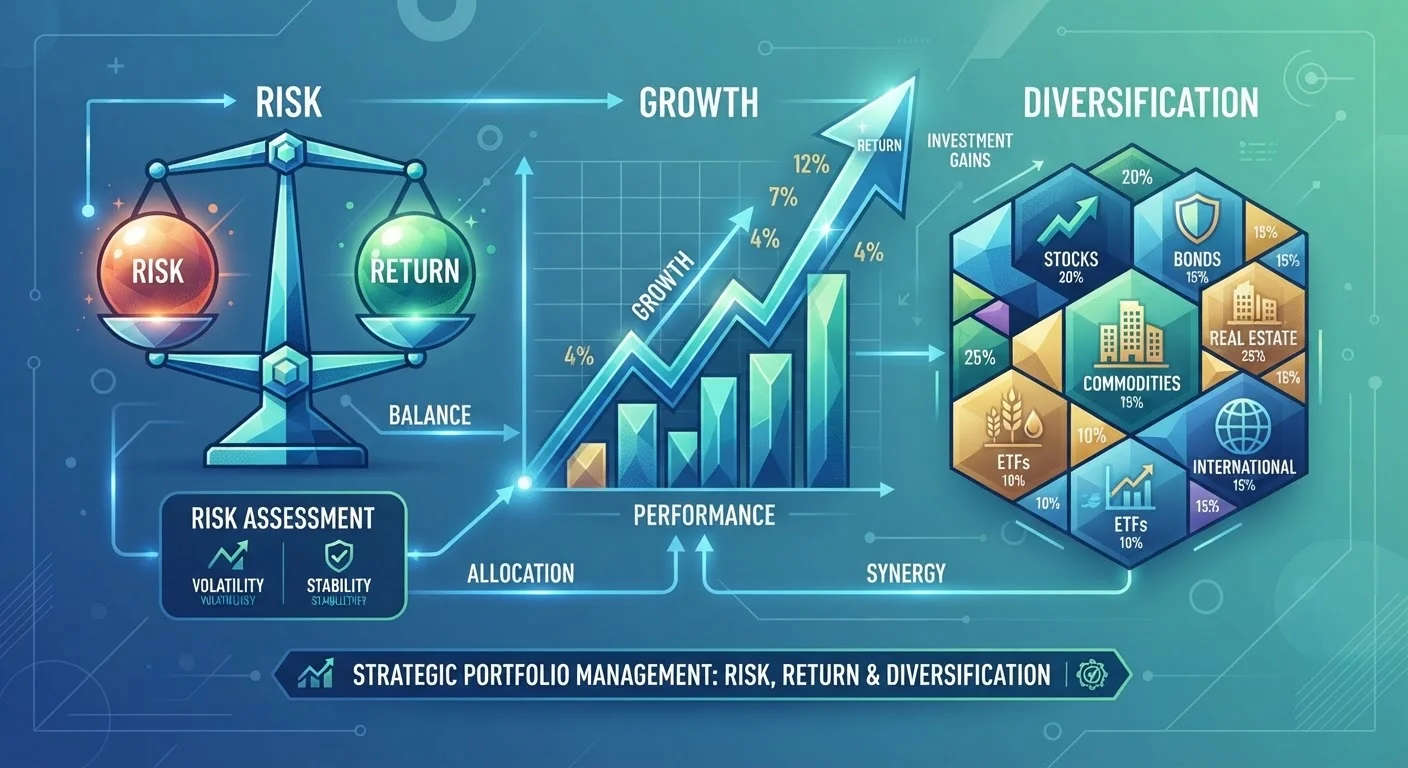
Photo: TrendingResults.net | Discover More, Trend More editorial
Key Takeaways
- Higher potential returns almost always come with higher risk - there is no reliable way around this tradeoff.
- Diversification reduces the damage any single bad investment can do to a portfolio.
- Risk tolerance varies by person, time horizon, and financial situation - no single allocation fits everyone.
- Diversification can lower risk without necessarily sacrificing long-run expected returns.
- Understanding these three concepts is the foundation for evaluating any investment strategy.
Risk: What You're Really Taking On
Every investment involves risk. That word gets used loosely, so it's worth being precise: in investing, risk means the possibility that your money grows less than expected - or decreases in value entirely.
There are several distinct types of risk worth knowing about. Market risk is the possibility that the broader market falls, pulling your investments down with it. Inflation risk is the danger that your returns don't keep pace with rising prices, meaning your purchasing power shrinks even if your balance grows. Concentration risk occurs when too much of your money is tied to a single company, sector, or asset type.
Risk isn't inherently bad - it's unavoidable, and accepting it is what allows investors to earn returns above what a savings account pays. The goal isn't to eliminate risk but to understand it, measure it relative to your situation, and take on only as much as makes sense for your goals. For a broader grounding in the language around these concepts, see our plain-English investing glossary.
~20-30
Stocks needed for substantial diversification
Academic research in portfolio theory, including foundational work by economists such as Edwin Elton and Martin Gruber, suggests that holding roughly 20-30 uncorrelated stocks can eliminate most company-specific risk.
~10%
U.S. stock market average annual return (long-run, pre-inflation)
Historical data from sources including NYU Stern's Damodaran database shows U.S. large-cap equities have averaged roughly 10% annually over the long run - though individual years vary widely, and past performance does not predict future results.
0%
Risk eliminated by diversification alone
Diversification can eliminate unsystematic (company-specific) risk, but it cannot eliminate systematic (market-wide) risk - meaning a well-diversified portfolio can still lose value during broad economic downturns.
Return: What Investing Is Actually Trying to Do
Return is the gain or loss on an investment over a given period, expressed as a percentage of the amount invested. If you invest $1,000 and it grows to $1,080 in a year, your return is 8%.
Returns come from two main sources: price appreciation (the investment increases in value) and income (dividends from stocks or interest payments from bonds). Total return accounts for both.
One concept that significantly affects long-run outcomes is compounding - earning returns on previous returns. Over long time horizons, compounding can have a substantial effect on an ending balance, which is why time in the market is often emphasized alongside the amount invested.
It's important to evaluate returns in context. A 12% return sounds excellent - but if it required taking on extreme risk to achieve, another portfolio producing 9% with far less volatility might represent a better outcome for many investors. Returns should always be considered alongside the risk required to generate them.
“Risk comes from not knowing what you're doing.”
— Warren Buffett, Chairman and CEO, Berkshire Hathaway; widely cited investor and author on value investing principles
Diversification: Spreading Risk Without Abandoning Return
Diversification is the practice of distributing investments across different assets, sectors, and geographies so that a poor performance in one area doesn't devastate the whole portfolio. The underlying principle is that different assets don't always move in the same direction at the same time.
Consider what happens if all of your money is in a single company's stock and that company faces a major setback. A diversified investor holding that same stock as a small fraction of a broader portfolio would feel a much smaller impact. This is what diversification is designed to do - reduce the harm from any single bad outcome.
There are multiple dimensions of diversification:
- Asset class: Stocks, bonds, real estate investment trusts (REITs), and cash equivalents behave differently from each other.
- Sector: Technology, healthcare, energy, and consumer staples don't always rise and fall together.
- Geography: Domestic and international markets can move differently based on regional economic conditions.
Diversification doesn't guarantee a profit or protect against all losses - particularly during broad market downturns. But it is one of the most widely supported strategies for managing risk over time. If you're wondering about common missteps, pitfalls that trip up new investors are worth reviewing before you get started.
How the Three Concepts Work Together
These three ideas don't operate in isolation - they're interlocked. Understanding how they connect is what allows you to evaluate any investment strategy, simple or complex.
The risk-return tradeoff is the starting point: pursuing higher returns means accepting more risk. Diversification is the practical tool that allows you to manage that risk - not by eliminating it, but by ensuring it's spread across enough positions that no single failure is catastrophic.
A well-diversified portfolio still takes on risk, and still seeks return. But it does so in a way that avoids unnecessary concentration. It's the difference between a strategy built on deliberate tradeoffs and one built on hope.
For anyone building their first portfolio or revisiting an existing one, starting from these three foundations makes it easier to assess what you own and why. Our complete beginner's overview of saving and investing walks through how these principles apply to real account types and investment vehicles.
This article is for general informational and educational purposes only and does not constitute personalized financial, investment, or tax advice. Investment involves risk, including possible loss of principal. Consult a licensed financial adviser before making decisions based on your individual circumstances.
Frequently Asked Questions
The content on this site is provided for informational purposes only and should not be considered a substitute for professional advice. While we strive to provide accurate and up-to-date information, we make no guarantees regarding its completeness or accuracy. Always consult a qualified professional for advice specific to your circumstances before making any decisions.