
Bodyweight Training: What It Can and Can't Do for Your Fitness

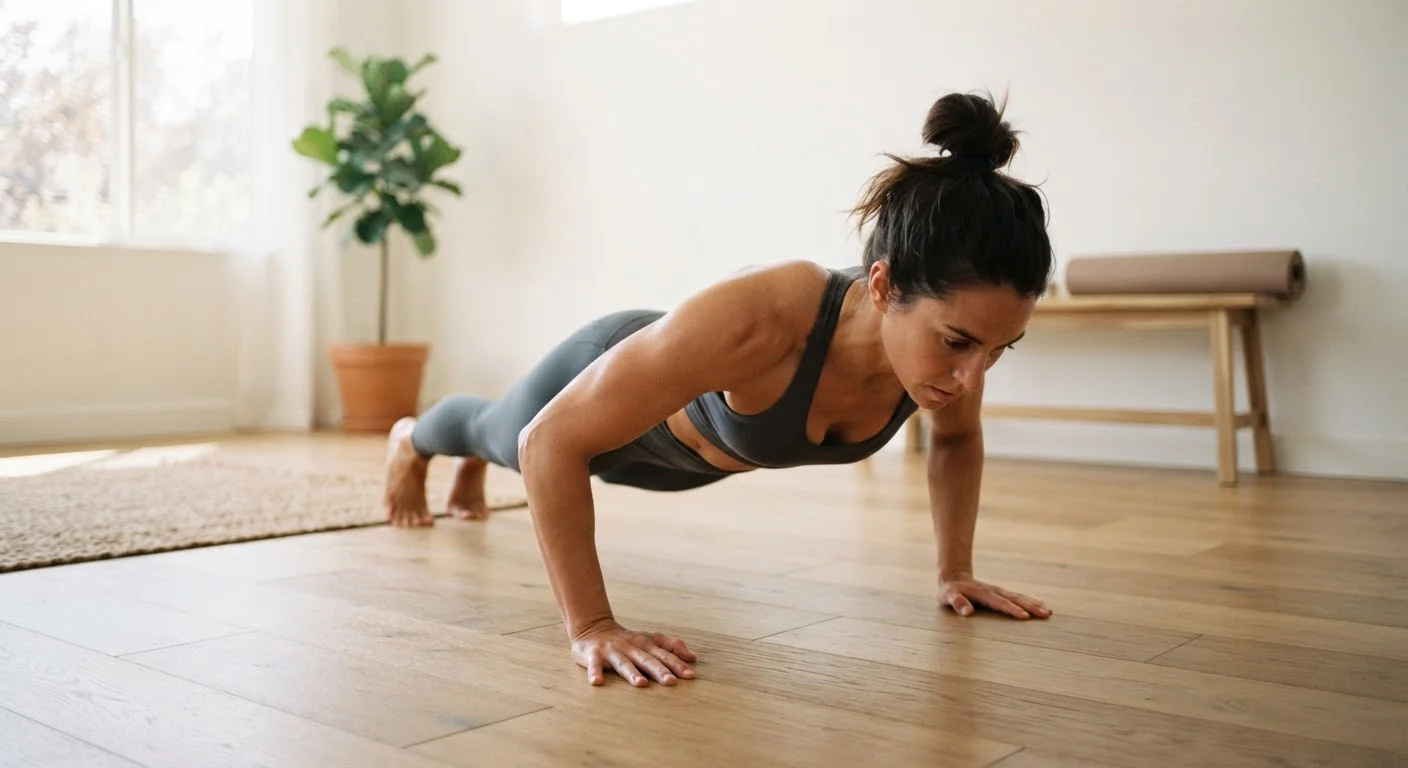
Photo: TrendingResults.net | Discover More, Trend More editorial
Key Takeaways
- Bodyweight training builds real strength and endurance without any gym equipment or cost.
- Progressive overload - doing more over time - is possible but harder to achieve than with free weights.
- Bodyweight methods work well for beginners and intermediates; advanced lifters may find them limiting.
- Combining bodyweight work with other training modes often yields the most balanced fitness results.
- Always consult a qualified healthcare professional before starting a new exercise program.
No cost or equipment required
Effective sessions need only a small floor space and your own body. This eliminates financial barriers and makes training possible anywhere - at home, traveling, or outdoors.
Builds functional strength and coordination
Multi-joint movements like push-ups, squats, and rows train muscles to work together rather than in isolation, which translates well to everyday physical tasks.
Scales from beginner to advanced
Movements have easier and harder variations. A wall push-up and a one-arm push-up are the same basic pattern - the gap between them is traversable through progressive skill development.
Lower injury risk for beginners
Without external loads, the forces on joints and connective tissue are generally more manageable during the early stages of building a fitness base.
Supports cardiovascular fitness when structured appropriately
Circuit-style bodyweight sessions - minimal rest, compound movements - can meaningfully elevate heart rate and improve aerobic capacity alongside muscular endurance.
Limited ceiling for building maximum strength
Once your bodyweight becomes a relatively light load, further strength gains require increasingly complex movement variations that demand technical skill rather than simple effort.
Harder to quantify and track progress
Adding five pounds to a barbell is straightforward. Moving from a standard to an archer push-up is a qualitative jump that's more difficult to measure and pace progressively.
Insufficient for significant muscle hypertrophy alone
Research on muscle growth suggests that heavier, externally loaded resistance is generally more effective at producing substantial size gains compared to bodyweight methods alone.
Some muscle groups are harder to target
The posterior chain - hamstrings, glutes, upper back - requires more creative programming to stress adequately without equipment such as pull-up bars or resistance bands.
Advanced progressions require significant skill investment
Movements like pistol squats or handstand push-ups demand balance, coordination, and mobility that can take months or years to develop, extending the learning curve considerably.
What Bodyweight Training Actually Is
Bodyweight training uses your own body mass as resistance, rather than external loads like barbells, dumbbells, or machines. Exercises range from foundational movements - push-ups, squats, lunges, and planks - to more demanding skills like single-leg squats, pull-ups, and handstand progressions.
It's worth distinguishing bodyweight training from general physical activity like walking. While walking offers well-documented health benefits (see what the research says about walking as exercise), structured bodyweight training applies principles of progressive overload - gradually increasing demands on the body over time - to drive adaptation. If terms like progressive overload are unfamiliar, the Practical Glossary of Fitness Terms offers clear definitions to build your foundation.
The Real Advantages
Bodyweight training earns its reputation for good reasons. Its most significant strengths are practical as much as physiological.
No cost or equipment required
Effective sessions need only a small floor space and your own body. This eliminates financial barriers and makes training possible anywhere - at home, traveling, or outdoors.
Builds functional strength and coordination
Multi-joint movements like push-ups, squats, and rows train muscles to work together rather than in isolation, which translates well to everyday physical tasks.
Scales from beginner to advanced
Movements have easier and harder variations. A wall push-up and a one-arm push-up are the same basic pattern - the gap between them is traversable through progressive skill development.
Lower injury risk for beginners
Without external loads, the forces on joints and connective tissue are generally more manageable during the early stages of building a fitness base.
Supports cardiovascular fitness when structured appropriately
Circuit-style bodyweight sessions - minimal rest, compound movements - can meaningfully elevate heart rate and improve aerobic capacity alongside muscular endurance.
~30%
Adults meeting aerobic and strength guidelines
According to the CDC, only around 24-30% of U.S. adults meet both aerobic and muscle-strengthening activity guidelines - a gap bodyweight training is well-positioned to help close given its accessibility.
2x/week
Minimum muscle-strengthening frequency recommended
The U.S. Department of Health and Human Services' Physical Activity Guidelines recommend muscle-strengthening activities on at least two days per week - a target achievable through bodyweight training.
Because no equipment is required, the barrier to entry is lower than almost any other training mode. That removes cost and access as obstacles - factors that genuinely keep people from exercising consistently. Research consistently identifies convenience as one of the strongest predictors of exercise adherence, making accessibility a genuine performance advantage, not just a nice-to-have.
Where It Falls Short
Honest assessment matters here. Bodyweight training has real limitations that can frustrate progress if you're not aware of them going in.
Limited ceiling for building maximum strength
Once your bodyweight becomes a relatively light load, further strength gains require increasingly complex movement variations that demand technical skill rather than simple effort.
Harder to quantify and track progress
Adding five pounds to a barbell is straightforward. Moving from a standard to an archer push-up is a qualitative jump that's more difficult to measure and pace progressively.
Insufficient for significant muscle hypertrophy alone
Research on muscle growth suggests that heavier, externally loaded resistance is generally more effective at producing substantial size gains compared to bodyweight methods alone.
Some muscle groups are harder to target
The posterior chain - hamstrings, glutes, upper back - requires more creative programming to stress adequately without equipment such as pull-up bars or resistance bands.
Advanced progressions require significant skill investment
Movements like pistol squats or handstand push-ups demand balance, coordination, and mobility that can take months or years to develop, extending the learning curve considerably.
The core challenge is that your bodyweight is fixed. Once you can perform 20 clean push-ups, progressing to harder variations (archer push-ups, one-arm progressions) requires significant technical skill, not just effort. This makes the progression curve steeper and less intuitive than simply adding a plate to a barbell. For those focused on maximal strength or substantial muscle hypertrophy, understanding what strength training does for your body can clarify why external load often becomes necessary at advanced levels.
How to Get the Most From It
The limitations above are navigable with thoughtful programming. A few principles make bodyweight training substantially more effective:
- Prioritize movement quality first. Many people rush toward harder variations before mastering fundamentals. Solid form in basic movements transfers directly to more advanced progressions.
- Use tempo and range of motion as variables. Slowing down the lowering phase of a squat or increasing range of motion (such as elevating feet during push-ups) increases difficulty without adding external weight.
- Track volume systematically. Progressive overload through sets, reps, and density (work done per unit of time) is measurable and should be recorded.
- Plan recovery. Adaptation happens between sessions, not during them. Rest days are a physiologically necessary part of training, not optional extras.
Combining Methods Often Works Best
For those weighing home-based training more broadly, comparing home and gym workout trade-offs provides useful context on cost, accountability, and equipment access that complements this analysis.
This article is for general informational purposes only and does not constitute medical or fitness advice. Consult a qualified healthcare or fitness professional before beginning any new exercise program, particularly if you have existing health conditions or injuries.
The content on this site is provided for informational purposes only and should not be considered a substitute for professional advice. While we strive to provide accurate and up-to-date information, we make no guarantees regarding its completeness or accuracy. Always consult a qualified professional for advice specific to your circumstances before making any decisions.