
Index Funds vs. Actively Managed Funds: A Structural Comparison

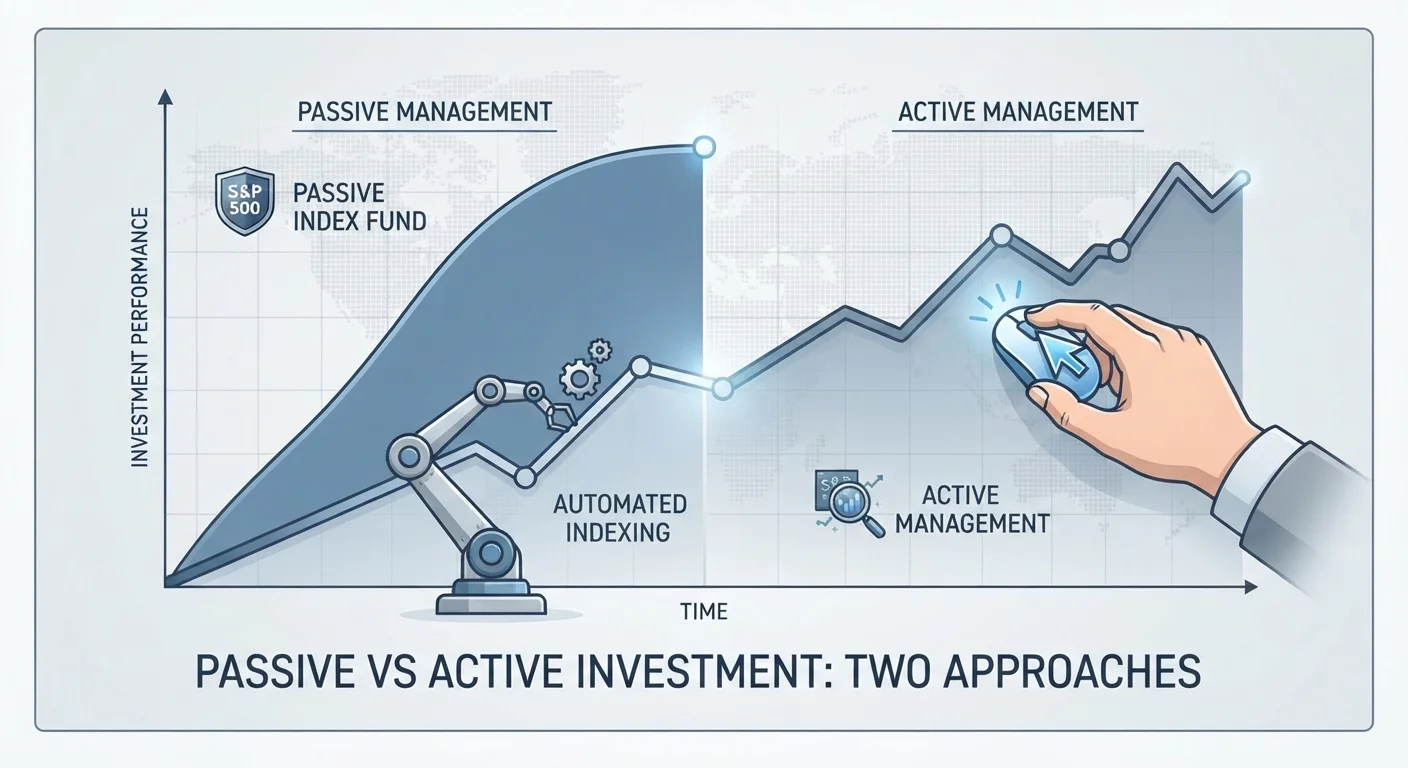
Photo: TrendingResults.net | Discover More, Trend More editorial
Key Takeaways
- Index funds track a market benchmark automatically; actively managed funds rely on human stock-selection decisions.
- Expense ratios for index funds are typically far lower than those for actively managed funds.
- Research consistently shows most actively managed funds underperform their benchmark index over long periods.
- Neither structure guarantees returns - both carry market risk and can lose value.
- The choice between the two often comes down to cost tolerance, time horizon, and investment philosophy.
How Each Fund Type Is Built
Before comparing costs and performance, it helps to understand what each fund structure is actually doing with your money. If you're new to terms like expense ratio or benchmark, the Plain-English Investing Glossary defines these clearly.
Index funds are designed to replicate the holdings of a market index - a predefined list of securities, such as the S&P 500 or the total U.S. bond market. The fund buys (and holds) essentially the same securities in the same proportions as that index. No analyst team is deciding what to buy or sell; the portfolio changes only when the index itself changes. This passive, rules-based structure is what keeps operating costs low.
Actively managed funds work differently. A portfolio manager - often supported by a team of analysts - makes ongoing decisions about which securities to hold, when to buy, and when to sell. The explicit goal is to outperform a stated benchmark index, not just match it. That research-intensive operation costs more to run, and those costs are passed on to investors through higher annual fees.
| Criterion | Index Funds | Actively Managed Funds |
|---|---|---|
| Management style | Passive - tracks a benchmark | Active - manager selects securities |
| Typical expense ratio | Often below 0.10% annually | Often 0.50%-1.00%+ annually |
| Goal | Match index performance | Outperform benchmark index |
| Trading frequency | Low - changes only with index | Higher - based on manager decisions |
| Tax efficiency (taxable accounts) | Generally higher | Generally lower |
| Transparency | High - holdings mirror the index | Variable - disclosed periodically |
| Long-run benchmark outperformance | Matches benchmark by design | Majority underperform after fees |
The Cost Gap and Why It Matters Over Time
The most concrete difference between these two structures is price. Index funds typically carry expense ratios - the annual fee expressed as a percentage of assets - well below 0.10% for widely available options. Many actively managed funds charge between 0.50% and 1.00% or more annually. That gap can seem small in any given year, but compounded across decades it represents a meaningful drag on returns.
85%+
Active large-cap funds underperforming over 15 years
According to S&P Global's SPIVA U.S. Scorecard, consistently more than 80-85% of actively managed large-cap U.S. equity funds have underperformed the S&P 500 over 15-year periods.
~0.05%
Typical index fund expense ratio
Many broad-market index funds now carry annual expense ratios at or below 0.05%, compared to industry averages for active funds that can exceed 0.60%-0.70%.
0.70%
Annual fee gap between fund types
The difference in expense ratios between a typical low-cost index fund and a typical actively managed fund often exceeds 0.60-0.70 percentage points per year, compounding significantly over time.
Consider a simplified illustration: if two portfolios each earn 7% gross annually but one pays 0.05% in fees while the other pays 0.75%, the higher-fee portfolio loses nearly 0.70 percentage points of compounding power every year. Over 30 years, that difference accumulates significantly - not because of investment performance, but purely from costs.
This is why cost awareness is a central theme in any beginner's guide to saving and investing. Fees are one of the few variables an investor can control before choosing a fund.
Performance: What the Research Shows
A persistent question in investing is whether active managers, on average, justify their higher fees by delivering better returns. S&P Global's SPIVA (S&P Indices Versus Active) reports - which track active fund performance against benchmarks over rolling periods - have consistently found that the majority of actively managed funds underperform their benchmark index over periods of 10 and 15 years, after fees.
This doesn't mean no active fund ever outperforms - some do, and some managers have sustained strong records. The challenge is identifying in advance which funds will outperform, and past outperformance has not proven to be a reliable predictor of future results. Survivorship bias also affects the data: funds that close due to poor performance are often removed from comparisons, making the active category's average look better than it was in practice.
Understanding risk, return, and diversification is essential context here - higher fees don't automatically mean higher risk-adjusted returns, and broader diversification (which index funds typically provide naturally) reduces exposure to individual security failures.
It's also worth noting that actively managed funds can offer value in specific contexts: niche asset classes, less liquid markets, or strategies designed to limit downside risk. The case for active management is weakest in highly efficient, heavily analyzed markets like large-cap U.S. equities.
Tax Efficiency and Practical Considerations
Because index funds trade infrequently, they tend to generate fewer taxable capital gains distributions within a given year. Active funds, by contrast, may buy and sell securities regularly in pursuit of returns, which can trigger taxable events for shareholders - even in years when the fund's overall return was modest. This distinction matters most in taxable accounts; inside tax-advantaged accounts such as IRAs or 401(k)s, it is less consequential. For a closer look at how account type interacts with investment strategy, see our comparison of Roth IRA vs. Traditional IRA.
Both fund types are widely available through brokerage accounts, employer retirement plans, and IRAs. Both can also be structured as ETFs (exchange-traded funds) or traditional mutual funds, which affects how and when you can buy or sell shares. Neither type eliminates market risk: when markets decline broadly, index funds fall with them. Active funds may or may not cushion that decline depending on manager decisions - but there is no guarantee either way.
This article is for general informational and educational purposes only and does not constitute personalized financial, investment, tax, or legal advice. Past performance of any fund type does not guarantee future results. Consult a qualified financial adviser before making investment decisions based on your individual circumstances.
The content on this site is provided for informational purposes only and should not be considered a substitute for professional advice. While we strive to provide accurate and up-to-date information, we make no guarantees regarding its completeness or accuracy. Always consult a qualified professional for advice specific to your circumstances before making any decisions.