
Insulation Types Demystified: Batts, Blown-In, Rigid Foam, and Spray

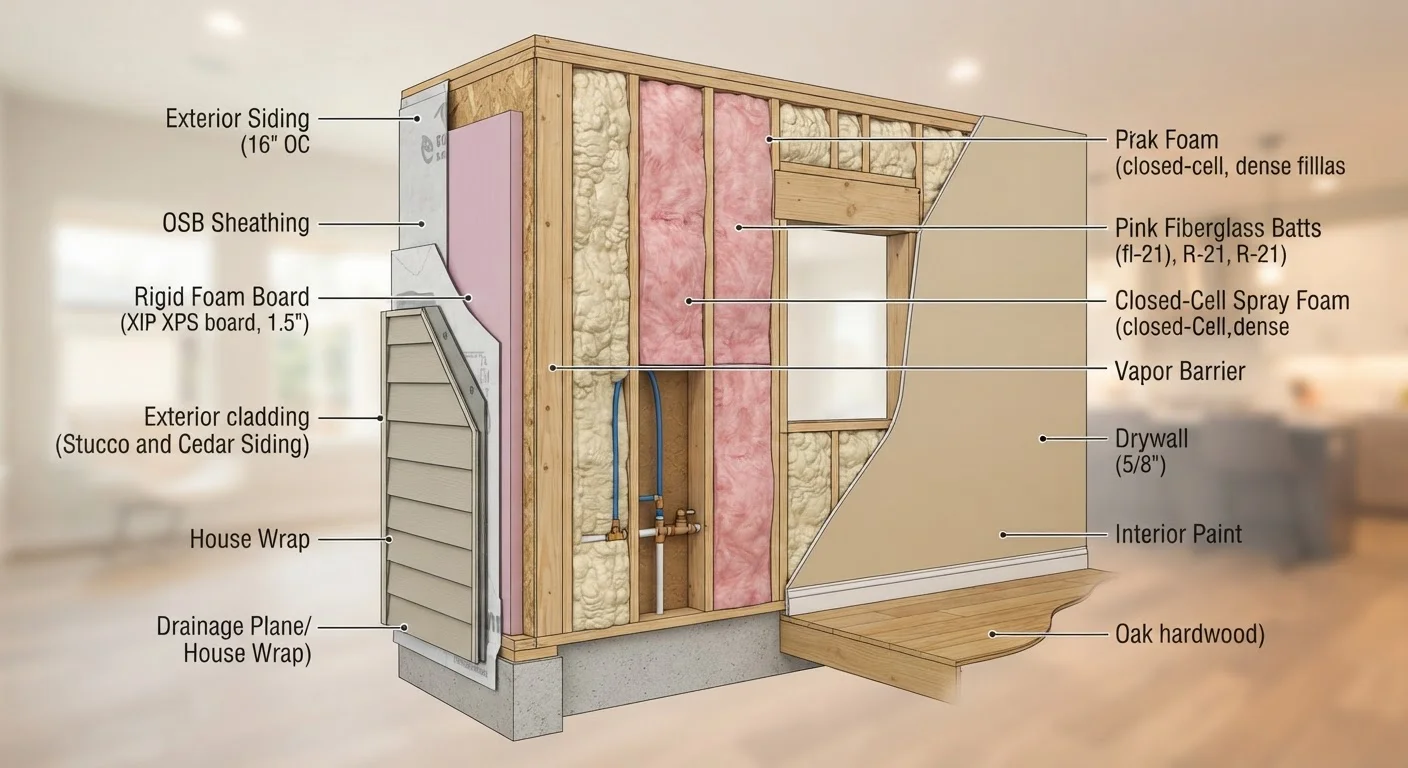
Photo: TrendingResults.net | Discover More, Trend More editorial
Key Takeaways
- R-value measures thermal resistance per inch; higher numbers mean better insulation performance.
- Batt insulation suits standard stud cavities best; blown-in fills irregular spaces more completely.
- Spray foam seals air leaks and insulates simultaneously, making it uniquely effective at stopping drafts.
- Rigid foam board adds insulation to flat surfaces like basement walls and exterior sheathing without cavity space.
- No single insulation type is ideal for every application - location and installation conditions matter most.
What R-Value Actually Measures
Before comparing insulation types, it helps to understand the metric that defines them all: R-value. R-value measures a material's resistance to heat flow. The higher the R-value, the more effectively the material slows heat transfer between the interior and exterior of your home.
R-value is cumulative - two layers of R-15 batt add up to R-30. It is also measured per inch of thickness for most materials, which is why a thinner spray foam can outperform a thicker fiberglass batt in a confined space. The U.S. Department of Energy publishes recommended R-values by climate zone, so the right target for a Minnesota attic differs significantly from one in Georgia.
Critically, R-value only measures conductive heat flow. It does not account for air infiltration. A material with a high R-value but poor air sealing can still allow significant heat loss through gaps and cracks - which is why installation quality is just as important as the number on the label. Learn more about how insulation fits into your overall home systems in our plain-language guide to major home systems.
Batt Insulation: The Familiar Standard
Batt insulation - typically made from fiberglass or mineral wool - comes in pre-cut panels sized to fit between standard 16-inch or 24-inch on-center wall studs and ceiling joists. It's the form most homeowners recognize from home improvement stores.
- Best applications: Open wall cavities in new construction, attic floors between joists, floors over unheated garages
- Typical R-value: R-3.1 to R-4.3 per inch depending on material and density
- Key limitation: Batts must fit snugly and without compression to achieve rated R-value. Gaps around wiring, pipes, or irregular framing reduce performance significantly.
Mineral wool batts (also called rock wool or slag wool) offer slightly higher R-values per inch than standard fiberglass and are more resistant to moisture and fire. Neither type seals air on its own - pairing batts with a proper vapor retarder and air barrier is standard practice in most climates.
Don't Skip the Air Barrier
Blown-In Insulation: Filling the Gaps
Blown-in insulation - made from cellulose (recycled paper), fiberglass, or mineral wool - is installed using a blower machine that forces loose material into a space. This makes it well-suited for situations where batts can't reach.
- Best applications: Existing attics, enclosed wall cavities via small drilled holes, oddly shaped spaces
- Typical R-value: R-2.2 to R-3.8 per inch depending on material and settling
- Key consideration: Cellulose settles over time, slightly reducing effective R-value, so installers typically overfill to compensate.
Blown-in cellulose also has a modest air-resistance advantage over fiberglass blown-in due to its denser packing. It's a common retrofit choice for attic upgrades because it can be added over existing insulation without major disruption. Professional installation is strongly recommended for wall cavities to ensure consistent density and avoid voids.
| Batt | Blown-In | Rigid Foam Board | Spray Foam | |
|---|---|---|---|---|
| Typical R-value per inch | R-3.1 to R-4.3 | R-2.2 to R-3.8 | R-3.8 to R-6.5 | R-3.5 to R-7 |
| Air sealing capability | None on its own | Minimal | Moderate (with taped seams) | Excellent |
| Best location | Open wall cavities | Attics, enclosed walls | Basement walls, sheathing | Rim joists, crawl spaces |
| DIY-friendly | Yes, with care | Possible with rental equipment | Yes, for surface applications | Small gaps only |
| Relative installed cost | Low to moderate | Low to moderate | Moderate | High |
| Retrofit suitability | Limited | Good | Good for exposed surfaces | Good for targeted areas |
Rigid Foam Board: Continuous Coverage
Rigid foam board comes in flat panels made from expanded polystyrene (EPS), extruded polystyrene (XPS), or polyisocyanurate (polyiso). Unlike cavity-fill insulation, foam board is applied to continuous flat surfaces.
- Best applications: Basement walls, exterior wall sheathing, under slab foundations, low-slope roofing assemblies
- Typical R-value: R-3.8 to R-6.5 per inch depending on foam type (polyiso performs highest)
- Key consideration: Some foam boards require a thermal barrier (such as drywall) on interior-facing surfaces for fire code compliance - always verify local requirements with a licensed contractor.
Rigid foam adds insulation without consuming interior space, which makes it valuable in basements and when retrofitting exterior walls. It also reduces thermal bridging through studs, a common weak point in standard framed walls. For a broader view of how heating systems interact with your insulation choices, see our breakdown of forced air, radiant heat, and heat pumps.
Spray Foam: The Air-Sealing Insulator
Spray polyurethane foam (SPF) is applied as a liquid that expands and hardens in place. It comes in two main forms: open-cell (lower density, lower R-value, permeable to vapor) and closed-cell (higher density, higher R-value, acts as a vapor retarder).
- Best applications: Rim joists, crawl spaces, attic rooflines, around windows and penetrations, anywhere air sealing is the priority
- Typical R-value: R-3.5 to R-4 per inch (open-cell); R-6 to R-7 per inch (closed-cell)
- Key consideration: Professional installation is essential. Uncured spray foam releases chemicals that require respiratory protection and temporary evacuation. DIY kits exist for small gaps but are not appropriate for large-scale applications.
Spray foam's ability to simultaneously insulate and seal air makes it uniquely effective in problem areas where batts or blown-in can't create a true air barrier. Closed-cell foam also adds structural rigidity to wall assemblies. Costs are substantially higher than other insulation types, so most homeowners use spray foam strategically rather than throughout an entire home. If contractor terminology feels unfamiliar, our homeowner's glossary of home systems terms can help you follow the conversation.
This article is for general informational purposes. Insulation requirements, fire codes, and permit obligations vary by location. Always consult a licensed contractor and verify local building code requirements before beginning any insulation project.
The content on this site is provided for informational purposes only and should not be considered a substitute for professional advice. While we strive to provide accurate and up-to-date information, we make no guarantees regarding its completeness or accuracy. Always consult a qualified professional for advice specific to your circumstances before making any decisions.