
Forced Air, Radiant Heat, and Heat Pumps: How the Main Heating Systems Actually Differ

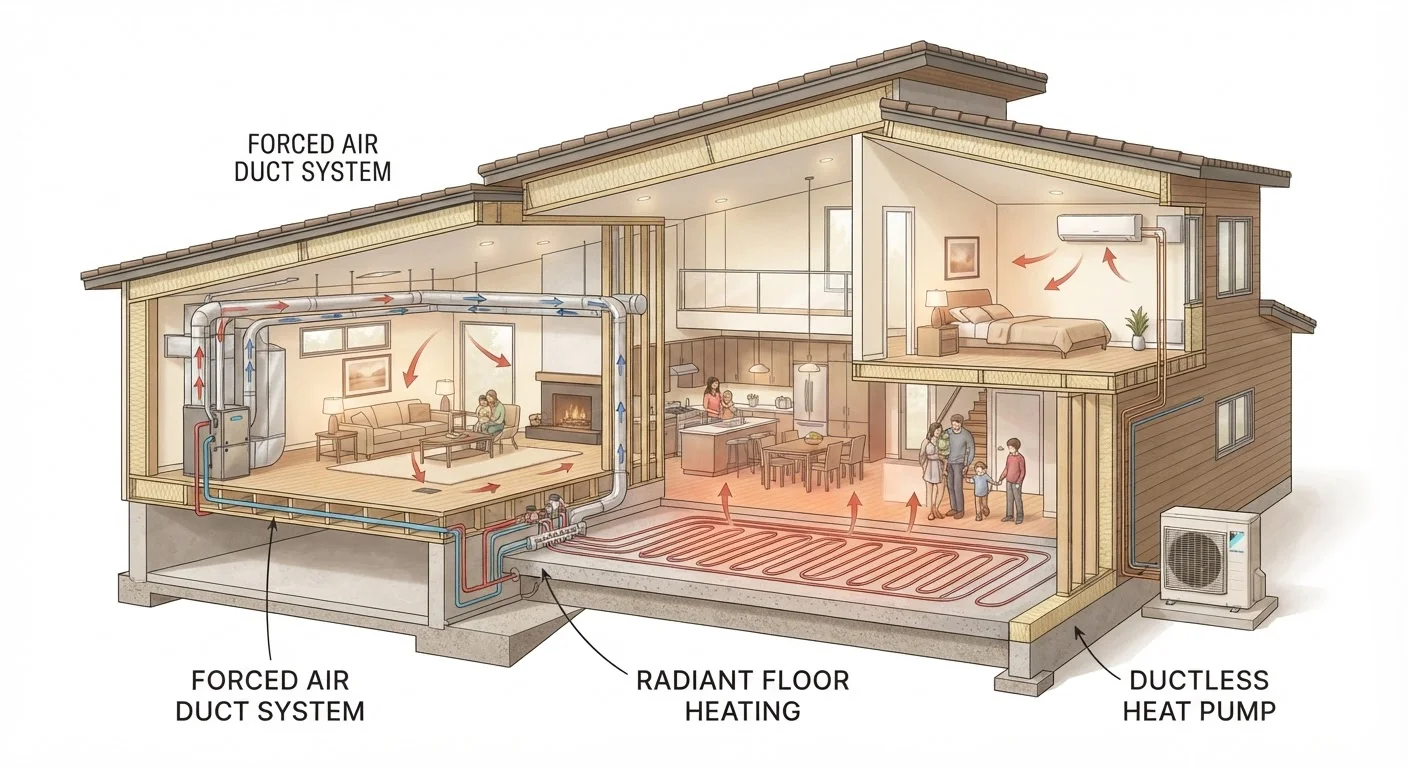
Photo: TrendingResults.net | Discover More, Trend More editorial
Key Takeaways
- Forced air systems heat quickly but can distribute allergens and lose efficiency through duct leakage.
- Radiant heat delivers exceptionally even, quiet warmth but costs more to install and responds slowly to thermostat changes.
- Heat pumps move heat rather than generate it, making them highly efficient in moderate climates but less effective in extreme cold.
- Your home's existing infrastructure - ductwork, slab vs. wood subfloor, climate zone - often shapes which system is practical.
- All three systems require routine professional maintenance to perform reliably over their lifespan.
How Each System Actually Generates and Delivers Heat
Understanding why these systems feel different starts with how they move heat into your living space.
Forced Air
A gas furnace (or electric air handler) burns fuel or uses electric resistance to heat air directly. A blower fan then pushes that warmed air through a network of ducts and out of supply registers. The system draws cool air back through return vents, reheats it, and repeats the cycle. Heat reaches rooms fast - typically within minutes - but it arrives in bursts as the thermostat cycles on and off.
Radiant Heat
Radiant systems embed heating elements - either hot-water tubing (hydronic) or electric resistance mats - beneath flooring, inside walls, or within ceiling panels. Heat radiates outward from the warm surface and warms objects and people directly, much like sunlight, rather than heating air. The result is exceptionally even warmth with no drafts, but the thermal mass of flooring means the system responds slowly - sometimes an hour or more - to thermostat adjustments.
Heat Pumps
A heat pump doesn't create heat; it moves it. Using refrigerant and a compressor, it extracts heat energy from outdoor air (even cold air contains heat energy) and concentrates it indoors. In summer, the process reverses to act as an air conditioner. Because it's transferring energy rather than burning fuel, a heat pump can deliver more heating energy than the electricity it consumes - a ratio expressed as its COP. Standard heat pumps lose efficiency as outdoor temperatures fall below about 35°F; cold-climate models extend effective operation to 0°F and below.
Installation, Infrastructure, and Compatibility
The practicality of each system is heavily shaped by what your home already has.
| Forced Air | Radiant Heat | Heat Pump | |
|---|---|---|---|
| Heat delivery method | Heated air through ducts | Radiant surface warmth | Transferred heat via refrigerant |
| Response speed | Fast (minutes) | Slow (30-90 minutes) | Moderate |
| Requires ductwork | Yes | No | Depends on type |
| Also provides cooling | Yes (with AC unit) | No | Yes (built-in) |
| Retrofit difficulty | Low (if ducts exist) | High | Moderate |
| Comfort level | Moderate (drafts, cycling) | High (even, quiet) | High (consistent) |
| Best climate fit | All climates | All climates | Moderate to cold (with cold-climate model) |
Forced air is the default in most American homes built after World War II, and that widespread ductwork is its biggest practical advantage. Adding a new furnace to an existing duct system is straightforward. Installing ducts from scratch, however, is invasive and expensive - a real concern in older homes or those with finished walls. Duct leakage, where conditioned air escapes into unconditioned attic or crawl space, can meaningfully reduce efficiency; sealing and insulating ducts is a common and worthwhile maintenance step. See our HVAC maintenance guide for what to inspect and when.
Radiant heat is most practical during new construction or major floor renovations, when tubing or mats can be embedded before flooring goes down. Retrofitting a hydronic system in an existing home requires a boiler, extensive piping, and typically new flooring - a significant project. Electric radiant mats are easier to retrofit under tile in bathrooms but are less practical as a whole-home solution due to operating costs. The quality of your home's insulation is especially critical with radiant systems, since slow response times mean heat losses are harder to compensate for quickly.
Heat pumps require an outdoor unit and refrigerant line sets. Ducted heat pumps can replace or supplement existing forced-air systems. Ductless mini-splits - a type of heat pump - work without any duct infrastructure and are worth comparing if your home lacks ducts; our article on central air vs. ductless systems covers those trade-offs in depth.
Comfort, Air Quality, and Noise
These systems create meaningfully different day-to-day living experiences.
Forced air produces temperature swings as the system cycles and can create drafts near registers. On the upside, the air handler can integrate air filtration and humidification - real advantages for people with allergies or in dry climates. Duct systems can harbor dust and allergens if not cleaned periodically.
Radiant heat is widely regarded as the most comfortable option. Heat rises evenly from the floor, temperatures stay consistent room to room, and there's no air movement to stir up dust. The system operates silently. The trade-off is that it does nothing for air quality (no filtration) and won't cool your home.
Heat pumps deliver consistent, even heat more comparable to radiant than to a furnace's blast-and-pause cycle - especially in mild weather. At very low outdoor temperatures, ducted heat pump systems sometimes include a backup electric resistance strip or gas furnace to supplement output. Noise levels from the outdoor compressor unit are a consideration for homes with bedrooms near the equipment.
Match System Choice to Your Climate Zone
Operating Costs and Long-Term Considerations
Energy costs depend on your fuel source, local utility rates, and climate - general patterns can guide thinking, but actual costs vary considerably by region.
Gas furnaces typically have lower operating costs than electric resistance heat in areas where natural gas is cheap. Heat pumps, however, can deliver two to four units of heat per unit of electricity consumed, often making them cheaper to operate than electric resistance heating and competitive with gas even where gas is inexpensive. This efficiency advantage narrows in very cold climates where backup heat engages frequently.
Radiant hydronic systems connected to a high-efficiency condensing boiler can be quite efficient, though the boiler itself adds a major mechanical component to maintain. Electric radiant mats, by contrast, are essentially electric resistance heating - comfortable, but costlier to run than a heat pump over a full heating season.
All three systems carry installation costs that vary widely by home size, local labor markets, and existing infrastructure. Budget conversations should happen with licensed HVAC contractors who can assess your specific situation. Whatever system you choose, operating costs are closely tied to your home's thermal envelope - a well-insulated, air-sealed home costs less to heat with any system. Our guide to insulation types can help you understand where your home may be losing heat.
For homes also thinking about domestic hot water - another major energy expense - the tankless vs. storage water heater comparison is a useful companion read when planning system upgrades.
The content on this site is provided for informational purposes only and should not be considered a substitute for professional advice. While we strive to provide accurate and up-to-date information, we make no guarantees regarding its completeness or accuracy. Always consult a qualified professional for advice specific to your circumstances before making any decisions.