
Tankless Water Heater vs. Storage Tank: Which Setup Fits Your Household?

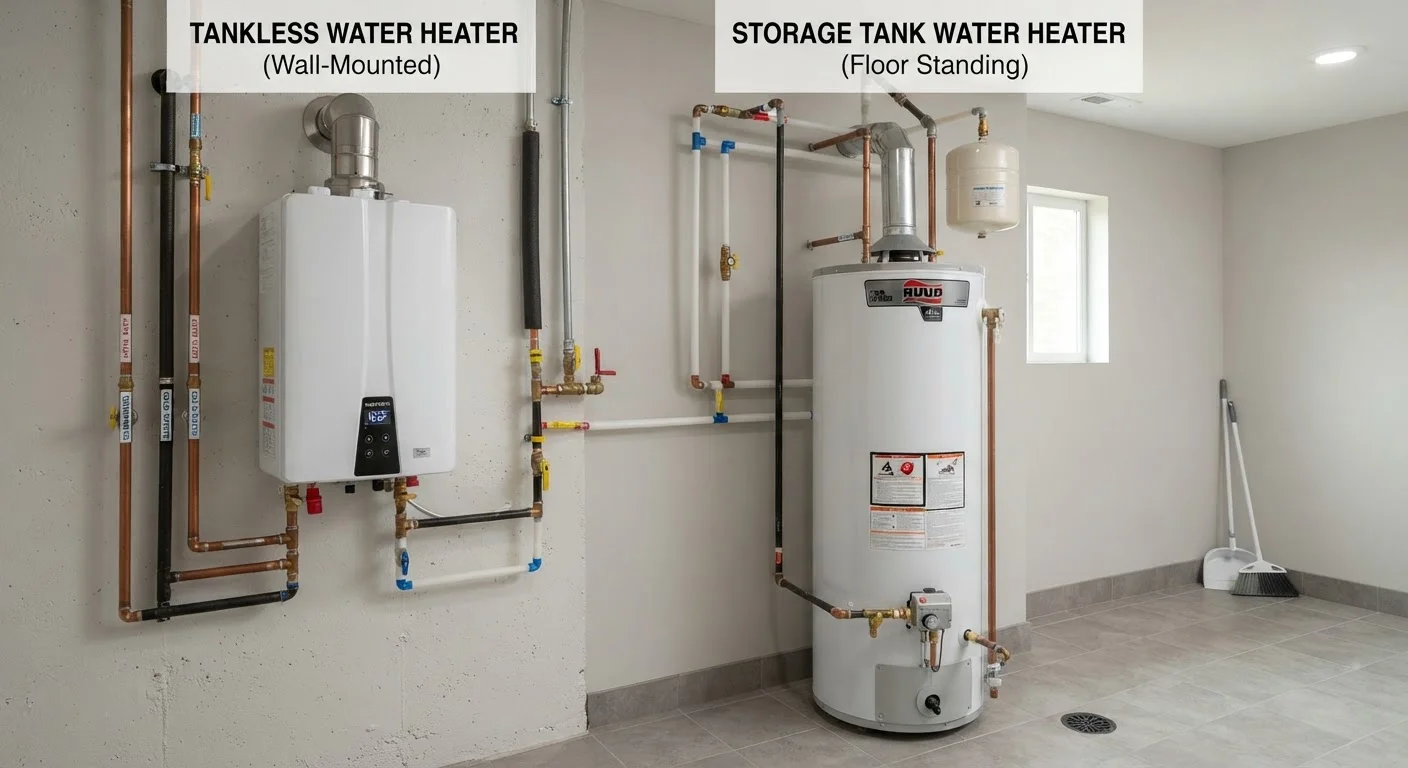
Photo: TrendingResults.net | Discover More, Trend More editorial
Key Takeaways
- Tankless heaters heat water on demand and can lower energy bills, but cost significantly more to install.
- Storage tank units hold 30-80 gallons and can run out during high-demand periods, but have lower upfront costs.
- Tankless units typically last 20+ years; storage tanks average 8-12 years.
- Whole-home tankless systems may require gas line or electrical panel upgrades.
- Your household size, peak usage patterns, and available space all shape which type makes sense.
How Each System Works
A storage tank water heater maintains a reservoir of hot water - typically 30 to 80 gallons - ready for use at any time. The unit continuously heats that stored water to a set temperature, which means energy is consumed even when no one is drawing hot water. This is called standby heat loss, and it's the defining efficiency trade-off of the tank design.
A tankless water heater (also called an on-demand heater) contains no reservoir. When you open a hot-water tap, cold water flows through a heat exchanger inside the unit and is heated instantly by gas burners or electric elements. Once the tap is closed, heating stops entirely - eliminating standby loss.
Understanding this distinction shapes almost every other comparison between the two: cost, efficiency, sizing, installation complexity, and long-term maintenance. For a broader look at how home comfort systems compare, see our guide on how major heating systems actually differ.
| Criterion | Tankless Water Heater | Storage Tank Water Heater |
|---|---|---|
| Upfront cost | Higher ($800-$2,500+ installed) | Lower ($300-$1,500 installed) |
| Energy efficiency | Higher - no standby heat loss | Lower - continuous standby loss |
| Hot water supply | Continuous (flow-rate limited) | Limited by tank capacity |
| Typical lifespan | 20+ years | 8-12 years |
| Space required | Compact, wall-mounted | Large floor footprint |
| Installation complexity | Often requires upgrades | Straightforward replacement |
| Maintenance needs | Annual descaling required | Annual flushing and anode check |
Installation, Cost, and Infrastructure
Storage tank heaters have a well-established installation footprint. A licensed plumber can typically replace an existing tank unit in a few hours using existing gas or electrical connections. Equipment costs generally range from a few hundred dollars for a basic unit to over a thousand for high-efficiency models, depending on capacity and fuel type.
Tankless units cost more upfront - often two to three times the equipment price of a comparable tank. Whole-home gas tankless heaters frequently require a larger-diameter gas line, and electric whole-home models may need a significant electrical panel upgrade. These infrastructure changes can meaningfully increase total installation cost. Point-of-use electric tankless units (small units serving a single fixture) are far less demanding and can be a practical add-on in specific situations.
8-12 yrs
Average storage tank water heater lifespan
The U.S. Department of Energy notes that conventional storage water heaters typically last between 8 and 12 years before replacement is needed.
24-34%
Potential energy savings with tankless heaters
According to the U.S. Department of Energy, homes using 41 gallons or less of hot water daily can see up to 34% greater energy efficiency with a tankless unit versus a storage model.
20+ yrs
Typical tankless water heater lifespan
Most tankless manufacturers and industry sources cite a service life exceeding 20 years when units are properly maintained and descaled regularly.
It's worth noting that installation costs vary considerably by region, home age, and local labor rates. Always get at least two estimates from licensed plumbers before committing, and verify that any work requiring permits is pulled correctly - unpermitted water heater installations can complicate home sales and insurance claims.
Efficiency, Lifespan, and Maintenance
Tankless heaters are generally more energy-efficient than storage tanks, primarily because they eliminate standby heat loss. The U.S. Department of Energy has noted that for homes using a moderate amount of hot water daily, tankless heaters can be noticeably more efficient than storage models. Homes with very high hot-water demand see a smaller efficiency gap, because the storage tank spends less time idling.
Lifespan is a meaningful differentiator. Storage tanks typically last 8-12 years; tankless units, when properly maintained, commonly reach 20 years or more. Our reference on the real lifespan of home appliances and systems covers expected service lives across your home's major systems.
Both types require periodic maintenance. Storage tanks benefit from annual anode rod inspection and sediment flushing. Tankless units need descaling - particularly in areas with hard water - to keep the heat exchanger performing well. If your home has hard water, pairing either system with a whole-house filter or softener can extend equipment life; our article on whole-house water filtration explains what those systems can and can't do.
Hard Water Accelerates Wear on Both Systems
Sizing and Household Fit
For storage tanks, the key sizing metric is first-hour rating - how many gallons the unit can deliver in the first hour of use starting from a full tank. Match this to your household's peak morning or evening demand. A tank sized too small will run cold before everyone has showered.
For tankless systems, the critical metric is flow rate, measured in gallons per minute (GPM). You size a whole-home tankless unit by estimating how many fixtures might run simultaneously and adding their individual flow rates. A single gas unit typically delivers 5-10 GPM, which is usually sufficient for two to three simultaneous uses - but climate matters too, since incoming cold-water temperatures affect how hard the unit works in colder regions.
Household size alone doesn't determine which system fits. A two-person household that runs a dishwasher, washing machine, and shower at the same time may strain a small tankless unit. A large family with staggered schedules might do perfectly well with a well-sized tank. Honest assessment of your actual usage patterns matters more than headcount alone.
The content on this site is provided for informational purposes only and should not be considered a substitute for professional advice. While we strive to provide accurate and up-to-date information, we make no guarantees regarding its completeness or accuracy. Always consult a qualified professional for advice specific to your circumstances before making any decisions.