
Download Speed vs. Upload Speed: Why the Difference Actually Matters

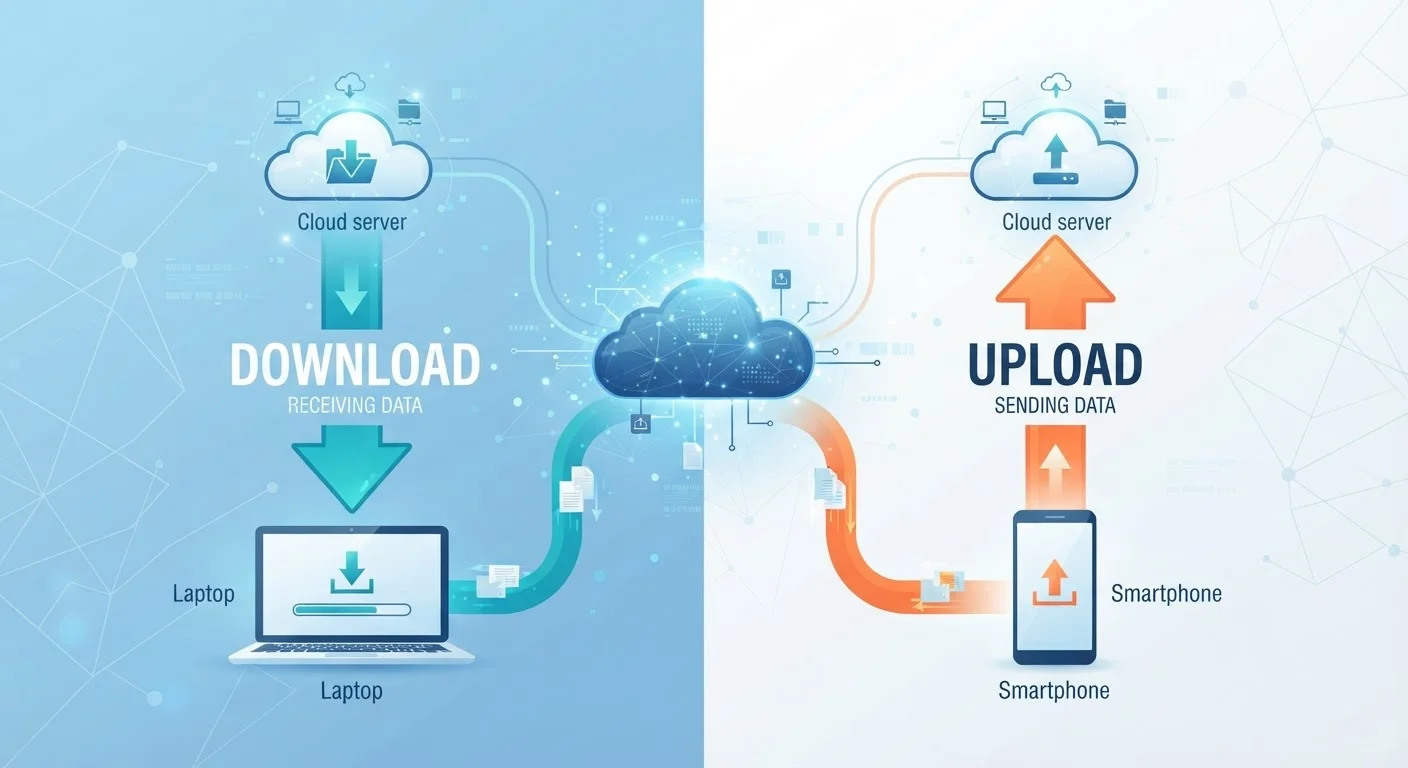
Photo: TrendingResults.net | Discover More, Trend More editorial
Key Takeaways
- Download speed measures how fast data travels from the internet to your device; upload speed measures the reverse.
- Most ISPs advertise download speeds prominently while offering upload speeds a fraction of that figure.
- Upload speed is critical for video calls, remote work file sharing, live streaming, and online gaming.
- Fiber internet connections typically offer symmetrical speeds, meaning upload matches download.
- Cable and DSL plans often deliver significantly slower upload speeds than their advertised download tiers.
- Running a speed test that measures both directions helps you evaluate whether your plan fits your actual usage.
The Basic Mechanics: What Each Speed Actually Measures
Internet speed is measured in megabits per second (Mbps) or, increasingly, gigabits per second (Gbps). But that single number advertised on a plan covers two very different directions of data flow.
Download speed is how fast your connection pulls data from the internet to your device. Every time you load a webpage, watch a Netflix episode, or receive an email attachment, that data is traveling downstream to you.
Upload speed is the reverse: how fast your device sends data to the internet. When you join a video call, post a photo, submit a form, or back up files to cloud storage, that data is traveling upstream from you.
These two directions run simultaneously and independently, which is why your connection can download at 400 Mbps while only uploading at 20 Mbps - a common reality on cable internet plans. Understanding both figures is fundamental to evaluating whether a plan genuinely fits your household. See how speed test results break down both directions to put real numbers to your own connection.
| Criterion | Download Speed | Upload Speed |
|---|---|---|
| Direction of data flow | Internet → your device | Your device → internet |
| Typical advertised prominence | Always featured prominently | Often listed in fine print |
| Common use cases | Streaming, browsing, downloads | Video calls, uploads, live streaming |
| Speed on cable plans | High (100-1,000+ Mbps) | Low relative to download (10-50 Mbps typical) |
| Speed on fiber plans | High (500-2,000+ Mbps) | Matches download (symmetrical) |
| Critical for remote work | Moderately important | Highly important |
| Critical for content creators | Less critical | Essential |
Why ISPs Emphasize Download Speed - And Why That's Misleading
Carriers focus their marketing on download speed for a straightforward reason: it's the larger number, and it resonates with consumers who associate higher numbers with better service. Regulatory bodies in the U.S. have historically defined broadband thresholds primarily around download performance, which reinforced this framing in public consciousness.
The problem is that this creates a real gap in consumer understanding. A plan advertised as "500 Mbps" might deliver upload speeds of only 20-25 Mbps - a ratio of 20-to-1. On cable networks, this asymmetry is built into the infrastructure: DOCSIS cable technology allocates far more channel capacity to downstream traffic than upstream. DSL connections carry similar asymmetry by design.
20:1
Typical cable download-to-upload ratio
Many standard cable internet plans deliver upload speeds just 5-10% of their advertised download figure, according to FCC Measuring Broadband America reports.
~5 Mbps
Upload needed per HD video call participant
Major video conferencing platforms recommend 3-5 Mbps sustained upload per active HD session, per their published technical requirements.
25 Mbps / 3 Mbps
FCC's legacy broadband definition threshold
The FCC's previous broadband benchmark was 25 Mbps download and 3 Mbps upload; it was updated to 100/20 Mbps in 2024 to better reflect modern usage demands.
This matters more than ever because internet usage patterns have shifted. A decade ago, most households were passive consumers of content. Today, remote work, video conferencing, social media uploads, and cloud-based collaboration tools have made upload speed a primary concern for a substantial share of users. ISP marketing myths often obscure these distinctions further.
Real-World Scenarios Where Each Speed Type Dominates
The right way to think about this isn't which speed is more important in the abstract - it's which direction your specific usage patterns demand most.
When download speed takes priority
- Streaming video: A 4K stream from a major platform requires roughly 15-25 Mbps downstream per screen. Upload plays almost no role here.
- General web browsing: Pages, images, and video content all arrive via download. A household of casual browsers needs ample downstream headroom.
- Gaming downloads and patches: Downloading a 100GB game update is entirely a download operation.
When upload speed takes priority
- Video conferencing: Platforms like Zoom or Teams transmit your camera and microphone feed upstream. A sustained call at HD quality can require 3-5 Mbps of stable upload per participant.
- Cloud backup and file sync: Services that automatically back up photos, documents, or device images upload continuously in the background, competing with other tasks.
- Live streaming: Broadcasting to a streaming platform is purely an upload task. Insufficient upload speed causes buffering and quality drops for your viewers, not you.
- Remote access tools: Screen-sharing and remote desktop applications transmit display data upstream from the host machine.
For a deeper look at how these demands stack up across a full household, estimating your household's real speed needs is a useful next step.
Symmetrical vs. Asymmetrical Connections: The Technology Divide
The gap between download and upload speeds isn't a policy choice - it's often a technology constraint. Understanding this helps you evaluate your options more clearly.
Asymmetrical connections - most cable and DSL plans - deliver substantially faster downloads than uploads. This was an acceptable trade-off when internet usage was primarily consumption-based, but it's increasingly mismatched with modern household behavior.
Symmetrical connections deliver equal download and upload speeds. Fiber optic internet is the most common source of truly symmetrical residential service. A fiber plan rated at 1 Gbps generally means 1 Gbps in both directions, which is a meaningful real-world advantage for anyone who uploads significant data regularly. Fiber vs. cable performance comparisons go deeper on why this symmetry matters under load.
Some newer cable standards (DOCSIS 3.1 and the emerging DOCSIS 4.0) are improving upload capacity on cable networks, but fiber remains the clearest path to symmetrical residential speeds in most markets.
This article provides general educational information about internet technology. Actual speeds, plan availability, and network performance vary by provider, location, and infrastructure. Verify current offerings directly with service providers in your area.
The content on this site is provided for informational purposes only and should not be considered a substitute for professional advice. While we strive to provide accurate and up-to-date information, we make no guarantees regarding its completeness or accuracy. Always consult a qualified professional for advice specific to your circumstances before making any decisions.