
Understanding 5G: What the Technology Actually Delivers vs. What's Still Catching Up

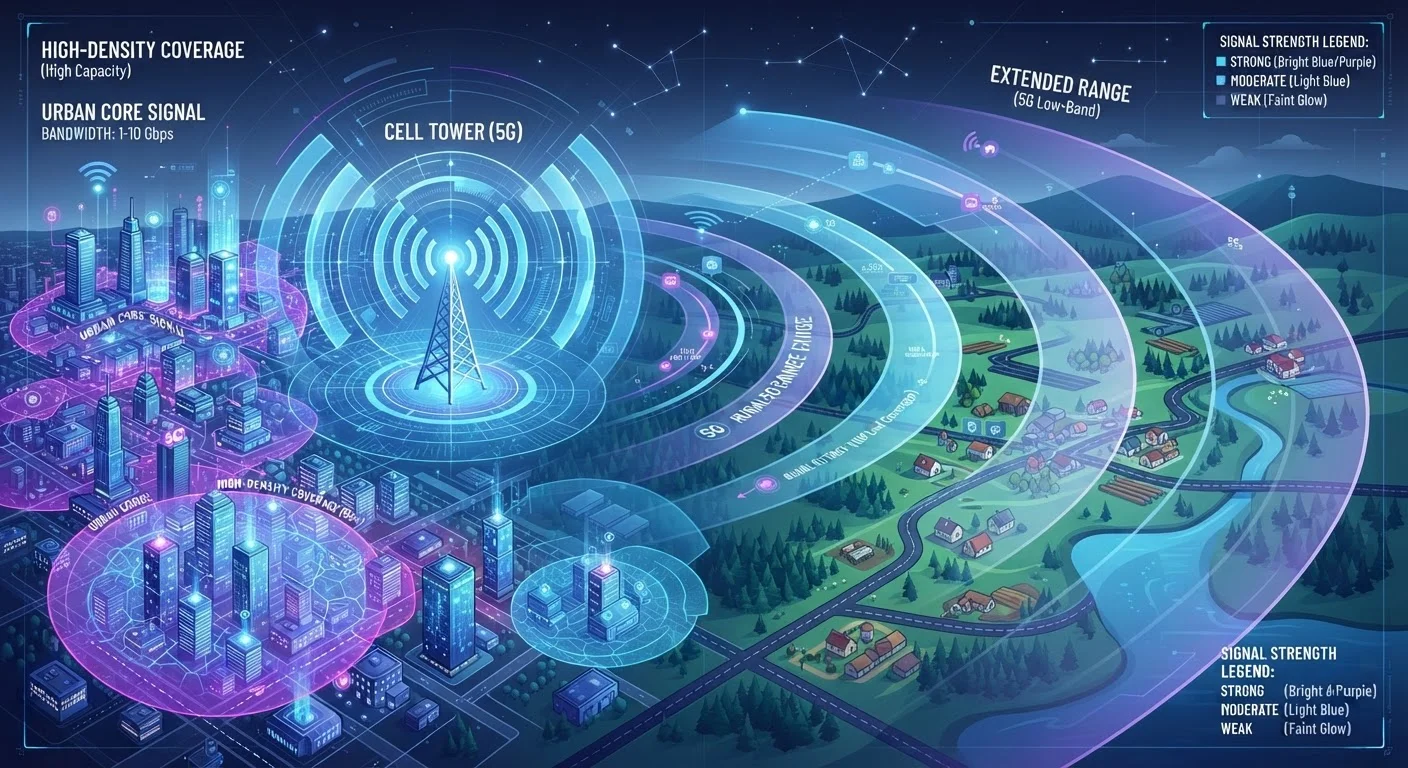
Photo: TrendingResults.net | Discover More, Trend More editorial
Key Takeaways
- Not all 5G is equal - the three frequency bands deliver dramatically different speeds and coverage.
- Low-band 5G covers the widest area but offers only modest speed improvements over LTE.
- Mid-band 5G is the most common urban experience, balancing speed and coverage effectively.
- mmWave 5G offers the fastest speeds but only works within a very short range of specific antennas.
- The 5G icon on your phone does not tell you which band you're connected to.
- Many advanced 5G capabilities - like network slicing and ultra-low latency - are still being rolled out nationwide.
Three Bands, Three Very Different Experiences
When a carrier says their network is "5G," that label covers three physically distinct types of spectrum - and they behave nothing alike. Understanding this distinction is the single most useful thing you can do before evaluating a wireless plan.
Low-band 5G (typically below 1 GHz) travels long distances and penetrates buildings well. It's what gives carriers the ability to say 5G reaches rural areas and suburbs. The catch: speeds are only modestly better than 4G LTE - often in the 50-100 Mbps range. If the 5G icon lit up on your phone and you didn't notice a difference, this is probably why.
Mid-band 5G (roughly 1-6 GHz, including the C-band spectrum auctioned in the U.S.) is the sweet spot. It delivers meaningfully faster speeds - commonly 200-400 Mbps in real-world conditions - while covering a practical geographic area. Most urban and suburban 5G deployments are trending toward mid-band, and it's what most people mean when they talk about 5G "actually working."
mmWave 5G (above 24 GHz) is the headline-grabbing tier. Theoretical speeds can exceed 1 Gbps, and real-world tests in optimal conditions have confirmed multi-hundred Mbps performance. But mmWave signals travel only a few hundred feet, can't pass through walls or windows, and require dense, expensive antenna infrastructure. It exists today mainly in specific spots inside airports, sports venues, and downtown corridors in major cities.
~35%
U.S. mobile connections on 5G networks
GSMA Intelligence estimates roughly one-third of U.S. mobile connections were on 5G networks by late 2023, with the majority of those on low-band spectrum.
300-400 ft
Typical effective range of mmWave 5G
Industry technical documentation consistently places the practical outdoor range of mmWave signals at a few hundred feet under optimal conditions, with significant degradation through walls or windows.
~10x
Speed difference between low-band and mmWave 5G
Real-world testing by independent analysts such as Ookla and RootMetrics has found peak speeds on mmWave can exceed 1 Gbps, while low-band 5G typically lands between 50-150 Mbps in practice.
What the 5G Icon on Your Phone Actually Means
Here's something carriers don't advertise prominently: the 5G indicator on your status bar tells you almost nothing about the quality of your connection. It only confirms you're associated with a 5G radio - not which band, not how congested the tower is, not what speed you can expect.
Some carriers have introduced sub-labels like "5G UW" or "5G+" to signal premium mmWave or mid-band connections, but these designations vary by carrier and aren't standardized across the industry. The practical result is that two people standing in the same city, on the same carrier's 5G plan, can have experiences that differ by a factor of ten in speed - depending on where exactly they're standing and which band their phone is using at that moment.
This is why carrier marketing language deserves scrutiny. A map showing 5G coverage and a map showing useful 5G coverage are not the same thing. If evaluating terms like "network priority" or "deprioritization" feels unfamiliar, the wireless plan glossary is a useful plain-language reference.
Run a Speed Test Before Assuming 5G Is Working
What 5G Actually Delivers Today - and What's Still Coming
For most consumers in 2024, 5G delivers two real improvements over late-stage LTE: faster peak speeds in congested areas, and reduced network latency (the delay between sending and receiving data). Both are genuine and measurable. In dense urban environments with mid-band coverage, streaming, video calls, and large file transfers do feel noticeably snappier.
But several capabilities that 5G is designed to enable remain in early or limited deployment:
- Network slicing - the ability to carve out dedicated bandwidth lanes for specific applications - is technically possible but not yet widely available to consumer plans.
- Ultra-low latency at the 1 millisecond level, often cited for applications like remote surgery or autonomous vehicles, requires edge computing infrastructure that most areas don't yet have.
- Fixed wireless access (FWA) as a home broadband alternative is live in more markets, though performance varies significantly by location and tower load. For context on how that compares to other non-traditional options, see our look at satellite internet trade-offs.
None of this means 5G is overhyped in a fraudulent sense - the technology foundation is real and improving. It means the gap between what's technically possible and what's deployed at scale is still meaningful, and it narrows gradually rather than all at once.
How to Apply This Before Choosing a Plan or Device
Knowing the three-band framework gives you a practical lens for evaluating your options. A few questions worth asking:
- What band does your carrier primarily use in your specific area? Coverage maps from carriers often distinguish between standard 5G and premium tiers - look for the fine print. Independent speed-test data from sources like Ookla's Speedtest can give a more grounded picture of real-world performance by geography.
- Does your current phone support the relevant bands? A 5G phone that only supports low-band won't benefit from mid-band infrastructure even if it's available overhead. Check your device's spec sheet for supported 5G bands (often listed as n77, n258, etc.).
- Is 5G actually necessary for how you use your phone? For most everyday tasks - social media, streaming at standard quality, navigation - a strong LTE connection is indistinguishable from low-band 5G in practice.
For a broader look at how 5G fits into the full picture of how your phone connects, see 5G, LTE, and Wi-Fi calling explained. And if internet speed claims more broadly have left you skeptical, common myths about internet speeds unpacks how marketing language shapes expectations.
The core takeaway: 5G is a real and evolving technology, but it's not a uniform experience. Where you live, what device you carry, and which plan tier you're on all shape what you actually receive - and that's worth knowing before you pay for it.
Frequently Asked Questions
The content on this site is provided for informational purposes only and should not be considered a substitute for professional advice. While we strive to provide accurate and up-to-date information, we make no guarantees regarding its completeness or accuracy. Always consult a qualified professional for advice specific to your circumstances before making any decisions.