
Reading Your Electrical Panel: Breakers, Amperage, and What the Labels Mean

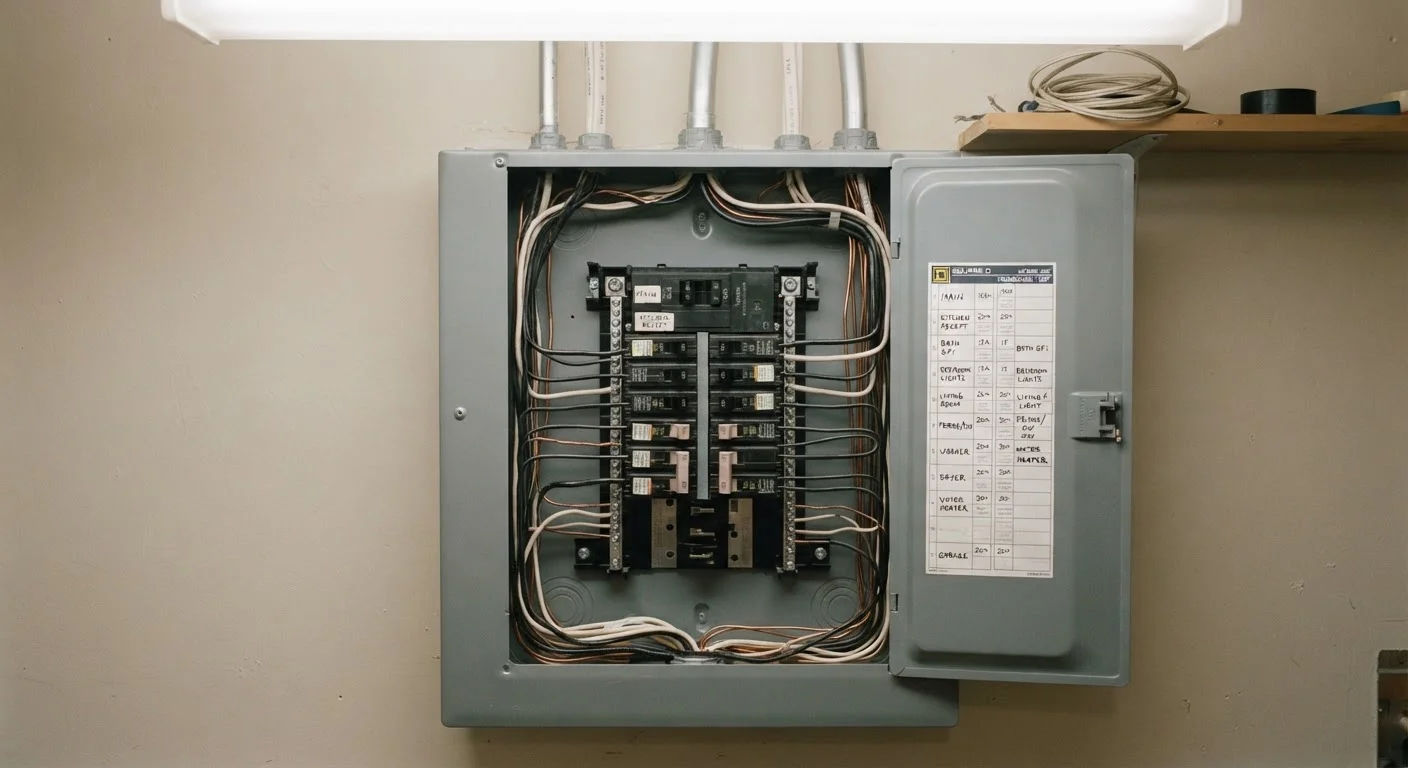
Photo: TrendingResults.net | Discover More, Trend More editorial
What the Electrical Panel Actually Does
Your home's electrical panel - sometimes called a breaker box, load center, or service panel - is the central hub that distributes incoming utility power to every circuit in your home. It receives electricity from the utility company, divides it into individual circuits, and provides a way to cut power to any one of those circuits safely.
For a broader look at how this fits into your home's overall infrastructure, see how plumbing, HVAC, and electrical systems work together.
| Typical Panel Capacity | 100A, 150A, or 200A (main breaker rating) |
| Standard Outlet Circuit | 15 or 20 amps at 120 volts |
| 240V Appliance Circuit | Double-pole breaker (30-50 amps typical) |
| Panel Lifespan | 25-40 years (varies by brand, environment, and load history) |
| Governing Code | National Electrical Code (NEC), adopted and amended by local jurisdictions |
| AFCI Requirement | Required in most living areas under recent NEC editions (Verify current local code adoption) |
Inside the panel you'll find three main areas: the main breaker at the top (or sometimes bottom), a series of individual circuit breakers in two columns, and the bus bars - metal strips that conduct power to each breaker row. The panel door typically has a directory card where circuits should be labeled by room or appliance.
Breakers: Types, Sizes, and What They Protect
A circuit breaker is an automatic switch designed to stop the flow of electricity when the current on that circuit exceeds a safe level. Rather than blowing like an old-style fuse, a breaker trips - flipping to a middle or OFF position - and can be reset once the overload or fault is resolved.
Circuit Breaker
An automatic switch that interrupts electrical flow when the current in a circuit exceeds a safe level. Unlike fuses, breakers can be reset after they trip.
Amperage (Amps)
The measure of electrical current flowing through a circuit. Each breaker is rated to a maximum amperage; exceeding it causes the breaker to trip.
AFCI Breaker
Arc-Fault Circuit Interrupter breaker. Detects dangerous electrical arcing inside wires or connections that could cause a fire, and cuts power before ignition occurs.
GFCI Breaker
Ground-Fault Circuit Interrupter breaker. Shuts off power within milliseconds when it detects current leaking outside the intended path, protecting against electric shock.
Main Breaker
The large double-pole breaker at the top (or bottom) of the panel that controls all power entering the home from the utility. Turning it off de-energizes all branch circuits.
Bus Bar
A metal conductor strip inside the panel that distributes incoming power to each row of circuit breakers. There are typically hot bus bars and a neutral/ground bar.
Double-Pole Breaker
A breaker occupying two adjacent panel slots, supplying 240-volt power. Required for high-demand appliances like electric dryers, ranges, and central air conditioning.
Tandem Breaker
A half-size breaker that fits two separate circuits into a single panel slot. Only permitted in panels specifically rated to accept them.
Single-Pole vs. Double-Pole Breakers
Single-pole breakers occupy one slot in the panel and handle 120-volt circuits. These serve most general outlets, lighting, and smaller appliances. Double-pole breakers occupy two adjacent slots and deliver 240 volts - required for high-demand appliances such as electric dryers, water heaters, ranges, and central air conditioning units.
AFCI and GFCI Breakers
Arc-fault circuit interrupter (AFCI) breakers detect dangerous arcing - the kind of electrical spark that can ignite a fire inside a wall. The National Electrical Code (NEC) has progressively required AFCI protection in more living areas over successive editions. Ground-fault circuit interrupter (GFCI) breakers cut power within milliseconds when they sense current leaking to ground, protecting against electric shock near water sources. Both types have a TEST button on the face of the breaker itself. For more terminology like this, the plain-language glossary for homeowners is a useful companion.
Reading Amperage Ratings
Every breaker is stamped with an amperage rating - the maximum current that circuit is designed to carry continuously. Common ratings include:
- 15 amps - Standard lighting and general outlet circuits
- 20 amps - Kitchen countertop outlets, bathroom circuits, garage outlets
- 30 amps - Electric dryers, some water heaters
- 40-50 amps - Electric ranges, large HVAC equipment
- 100-200 amps (main breaker) - The total capacity entering the home from the utility
The panel's total amperage (typically 100A, 150A, or 200A in most modern homes) represents the maximum load the entire panel can handle at once - not the sum of all individual breakers, which routinely exceeds that figure. Panels are sized on the assumption that not every circuit runs at capacity simultaneously.
If your home has a 60-amp or older 100-amp panel and you're adding major appliances or an EV charger, a licensed electrician should assess whether an upgrade is warranted. Panel age and condition also factor into that decision - see expected service lives for electrical panels and other systems for context.
Decoding Panel Labels and When to Call a Pro
The directory card on your panel door should map each breaker number to a specific area or appliance. If labels are missing, incomplete, or wrong - a common situation in older homes - it's worth updating them systematically, ideally with a helper to test outlets room by room while you toggle breakers.
Look for these numbers stamped directly on each breaker: the amperage rating (e.g., 15, 20, 30) and sometimes a voltage rating. Tandem or half-size breakers fit two circuits into one slot and are only permitted in panels rated to accept them (check the panel's label inside the door).
Some situations go beyond reading labels and call for a licensed electrician:
- Breakers that trip repeatedly without an obvious overload cause
- A breaker that won't reset or feels warm to the touch
- Burn marks, corrosion, or a burning smell near the panel
- Labels that don't match actual circuits, suggesting prior unpermitted work
- A panel model that has been subject to safety recalls
Learn which warning signs in your wiring warrant a professional inspection before a small issue becomes a larger one.
This article is for general informational purposes only. Electrical work involving your panel, service entrance, or wiring should be performed by a licensed electrician. Always verify local code and permit requirements before undertaking any electrical project.
The content on this site is provided for informational purposes only and should not be considered a substitute for professional advice. While we strive to provide accurate and up-to-date information, we make no guarantees regarding its completeness or accuracy. Always consult a qualified professional for advice specific to your circumstances before making any decisions.